
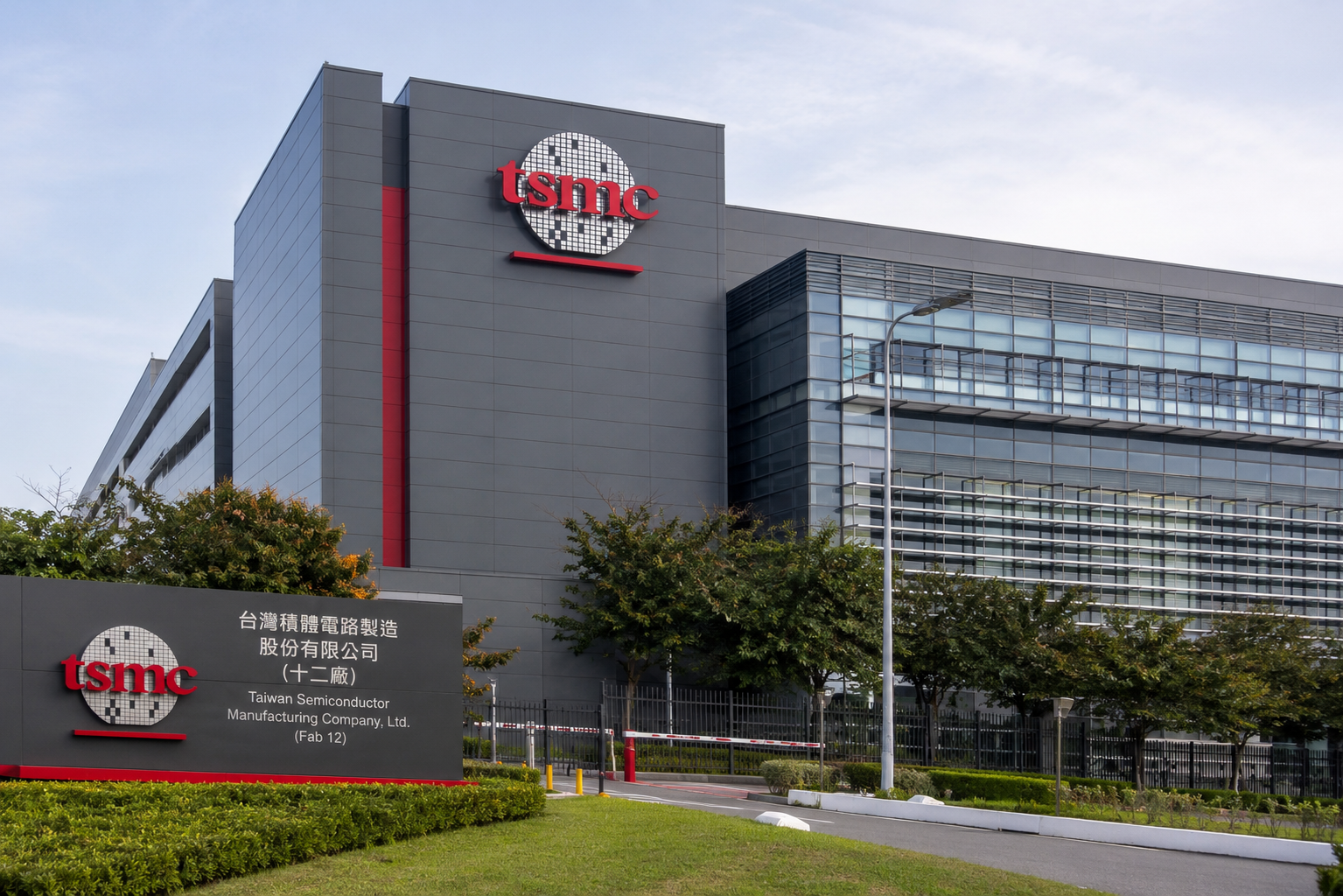
Shares of Taiwan Semiconductor Manufacturing Co. (TSMC) declined in US trading on Thursday despite the company posting record second-quarter earnings and raising its long-term investment plans.
The decline suggests investors may be focused on higher capital spending and the potential impact of US manufacturing expansion on margins.
TSMC’s US-listed shares fell more than 2.2%, while its Taiwan-listed stock ended the session over 1% higher after the earnings announcement.
The world’s largest contract chipmaker, regarded as a key barometer for artificial intelligence demand, reported second-quarter net profit of T$706.6 billion ($22 billion), up 77% from a year earlier and well ahead of market expectations of T$632.6 billion.
It marked the company’s ninth consecutive quarter of double-digit profit growth.
Revenue came in at T$1.27 trillion ($39.45 billion), slightly above analysts’ expectations of T$1.264 trillion.
TSMC projected third-quarter revenue between $44.6 billion and $45.8 billion, comfortably ahead of Wall Street expectations of roughly $43.1 billion.
The company also guided for an operating profit margin of 56% to 58% during the third quarter.
Increased 2026 capex raises concerns among investors
However, investors appeared more concerned about management’s revised spending plans than the earnings beat itself.
TSMC increased its 2026 capital expenditure forecast to between $60 billion and $64 billion, up from its previous guidance of the upper end of a $52 billion to $56 billion range.
The higher spending reflects continued investment in advanced manufacturing capacity to meet surging AI chip demand, but also raised concerns over near-term profitability.
The company simultaneously unveiled an additional $100 billion investment in Arizona, expanding its US manufacturing footprint as part of broader efforts to diversify production outside Taiwan.
Gytis Zizys, an analyst at Seeking Alpha, said the higher capital expenditure likely contributed to the stock’s decline.
“Another reason might be that the company raised its capex forecast to over $60B, which is a lot; however, I think this is totally necessary to remain on top of the game and be the top foundry in the world,” Zizys said.
“To be competitive in this day and age, companies like TSMC have to keep up with the spending that AI hyperscalers are doing right now; otherwise, they will go to the next foundry, which would be hard to do given the complete dominance of advanced processes by TSM.”
He also noted that investors were reacting to the expected margin impact of the company’s next-generation manufacturing nodes.
“As the more advanced nodes come online, specifically the 2-nanometer node, which is going to be done in the US, it is going to dilute its margins,” he said.
“At first, the management said that it would be 2%-3%, and then it will widen to 3%-4% in the latter stages. I don’t think this is such a bad outcome given the company’s profitability and the overall demand for AI chips by all of the hyperscalers. The increase in overall revenue will more than offset the loss in margins, in my opinion.”
KGI Securities raises PT on Taiwan-listed stock
Brokerages largely maintained their positive view on TSMC despite the market’s muted reaction.
KGI Securities raised its price target on the stock to NT$3,200 from NT$3,000 while maintaining an Outperform rating, citing higher earnings expectations.
The stock currently trades at NT$2,470.
The brokerage based its revised valuation on 20 times forecast earnings per share for the second half of 2027 through the first half of 2028.
KGI analyst Michael Liu acknowledged that some investors may be disappointed by the lack of upside surprises in the quarterly results and may worry about margin dilution following the updated guidance.
However, he argued that the company’s technology leadership remains its biggest competitive advantage.
“While investors may be somewhat deflated by the lack of upside surprises in 2Q26 results, and may even harbor concerns about margin dilution (particularly from gross margin guidance), we suggest investors focus on the company’s sustained, outstanding technology leadership and how still-strengthening AI-related demand will drive a robust long-term earnings CAGR,” Liu said.