

As America celebrates its 250th, there’s something happening inside its economy that’s not getting enough attention.
A quiet boom.
It’s one more thing worth celebrating this month–and we’re going to do that. We’re also going to get set for the next leg of America’s low-key growth run with a closed-end fund (CEF) yielding north 11.6%.
The chart below, which The Economist published two years ago, nicely sums up the wealth-building power of the US economy over the long haul.
The key piece of info here is on the left side of this chart. Here, we can see that over the last century, each generation of Americans has started its working career earning more than previous ones. And, yes, this data is inflation-adjusted.
No matter how you slice it, America is getting wealthier, generation by generation.
I know that this kind of optimism feels a bit, well, off these days, going by the negativity we read in the press. But the facts are clear. And we can bring this up to the present day by looking at Americans’ disposable income: It’s done nothing but march higher.
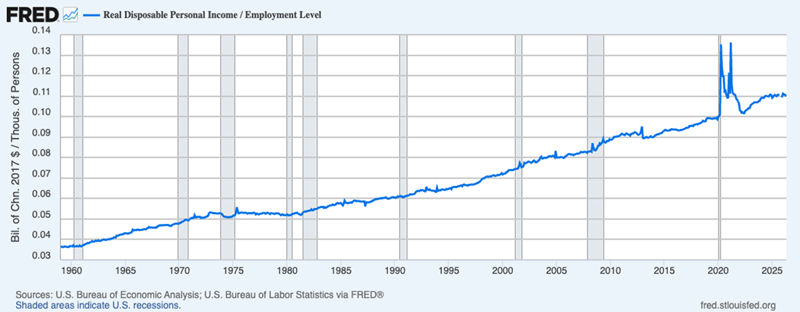
Here we see the amount of inflation-adjusted disposable income each worker has, on average. Right now, it’s around $11,072 per person per year, or double what it was 40 years ago.
That’s striking. And despite the gloom hanging over the job market these days, the average person’s employment prospects still look good, with the jobless rate at 4.2%.
Nonetheless, the disconnect between these bullish numbers and consumers’ dour mood is real. You can clearly see it below:
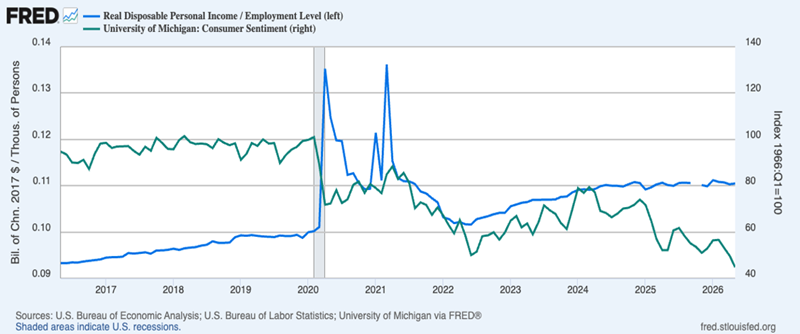
The blue line shows disposable income steadily rising, with things going temporarily haywire during the pandemic, when disposable income suddenly skyrocketed.
Disposable income has since retreated to the normal upward trendline, but no matter. Consumer sentiment (the green line) has slumped, and remains in the dumps years after the last lockdowns ended. Perhaps the memory of all that extra money during COVID is at play here.
In any case, one thing that certainly is true is that inflation is higher than it was in the 2010s–so much so that economists have accepted that we’re probably going to have 3% inflation on average instead of 2% for the long haul. But the fact remains: Americans are still earning more and have more to spend, and this trend has moved steadily along for a hundred years.
An 11.6% Dividend With a “Buy American” Kicker
What America has accomplished over the last 250 years is incredible, especially since we’ve now seen an entire century of growing wealth as a result.
Which is where the Liberty All-Star Equity Fund (USA) comes in–and not only for its patriotic ticker. In one go, the CEF gives us exposure to leading US firms like NVIDIA (NVDA), Microsoft (MSFT), Alphabet (GOOGL) and Amazon.com (AMZN).
But it’s not all about tech: Capital One Financial (COF), Visa (V) and health insurer Humana (HUM) show up among its top-10 holdings, too. USA takes its gains on this portfolio and “converts” them into that 11.6% dividend. And as you’d expect in a rising market, that payout has been growing.
USA’s Big–and Rising–Payout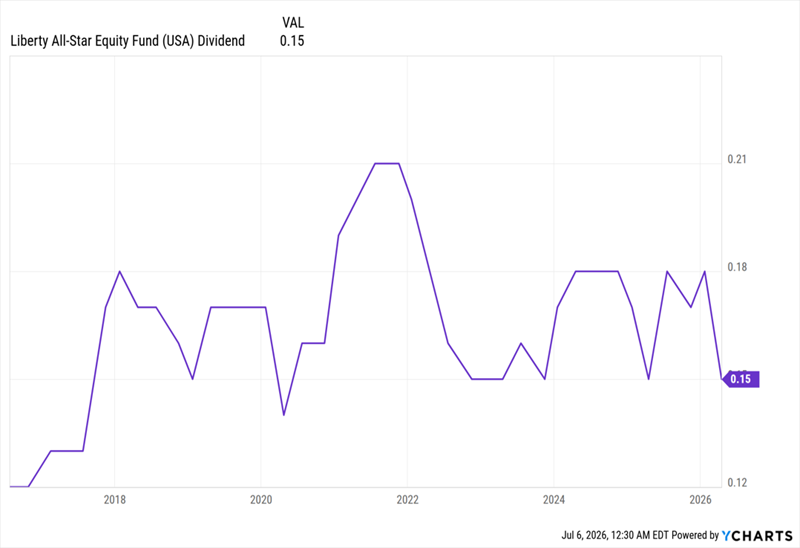
The fund fuels its dividend by aiming to return 10% of its net asset value (NAV, or the value of its underlying portfolio) as payouts every year. That’s why the line above tends to fluctuate over time.
That upward trend in the dividend is, as a result, tied to the fund’s performance: Over the last decade, USA’s market price-based total return has more than tripled (in purple below), with its total-return NAV (in orange) not far behind.
USA Marches Higher (No Matter How You Measure It)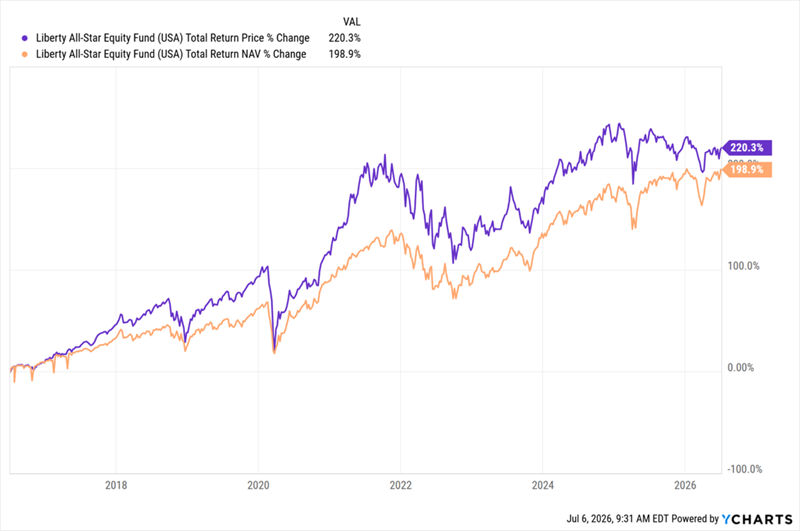
At the right side of the chart above, you’ll see that the fund’s total NAV return is starting to reel in its market price-based return. That’s resulted in a discount to NAV (the main valuation indicator among CEFs) of 12.9%.
That’s a level not seen since 2017. And it’s completely out of step with the strength of this fund’s performance over time–not to mention its rising payout:
USA’s Back-to-2017 Sale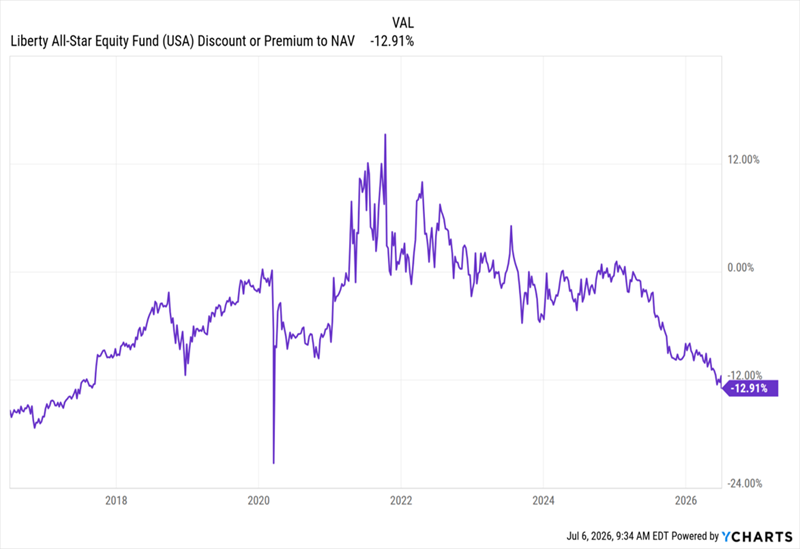
The power of USA’s high dividend, over time, should not be underestimated, either. The chart below tells the tale of two hypothetical investors: one who bought $100K of USA a decade ago and reinvested their payouts (in orange) and one who used the fund’s dividends to pay their bills, relying solely on USA’s price gains for growth.
Both tales are happy ones:
USA Is a Long-Term Winner, No Matter What You Do With the Dividends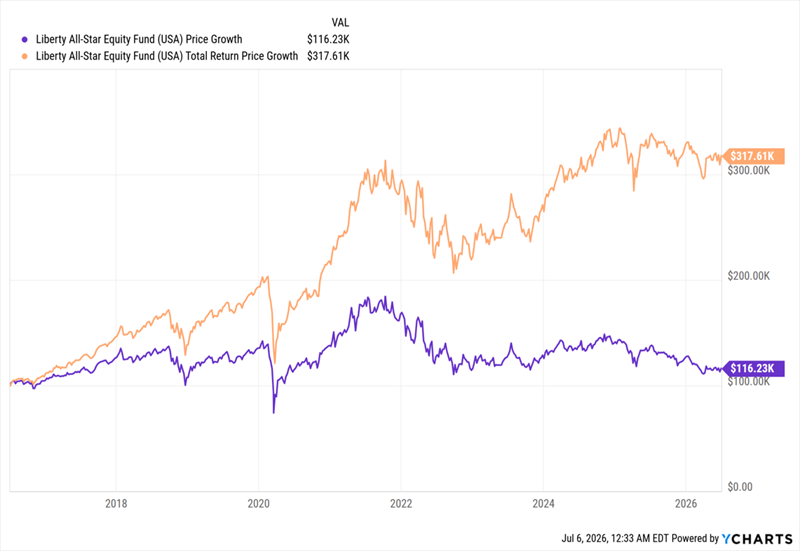
As you can see, an investor who bought USA a decade ago and used the fund’s dividend to pay for living expenses would have still seen their $100,000 initial investment rise to $116,230. Not bad! And our investor who reinvested their payouts would now have a holding worth $317,610.
It just goes to show that a CEF like USA is a smart way to ride along with America’s long-term growth–whether we need the income generated by that growth or not.
4 More “Star-Spangled” 10%+ Dividends as America Turns 250
This quiet boom isn’t just about the American economy as a whole. It’s fueled by several “mini-booms” happening in specific sectors.
Like pharma, where AI is slashing drug-development times, setting up billions more in sales for drugmakers.
Or on the factory floor, where AI-powered robots can make their own decisions, in real time, slashing costs and boosting product quality.
The best news for us is that CEFs give us a way to tap these “mini-booms” while grabbing big income streams at the same time.
I’ve got 4 such funds on my radar now. These 4 “all-American” picks yield 10% on average and, like USA, they’re all overlooked bargains (for now!).
As the media narrative (inevitably) flips from gloom to growth, these discounts will vanish, and the biggest gains will be gone.
That’s why, if we want to avoid leaving money on the table here (and we do!), we need to make our move now. Click here to learn more–and to get a free Special Report naming the four 10%-paying funds that get you in on the ground floor.